Introduction:
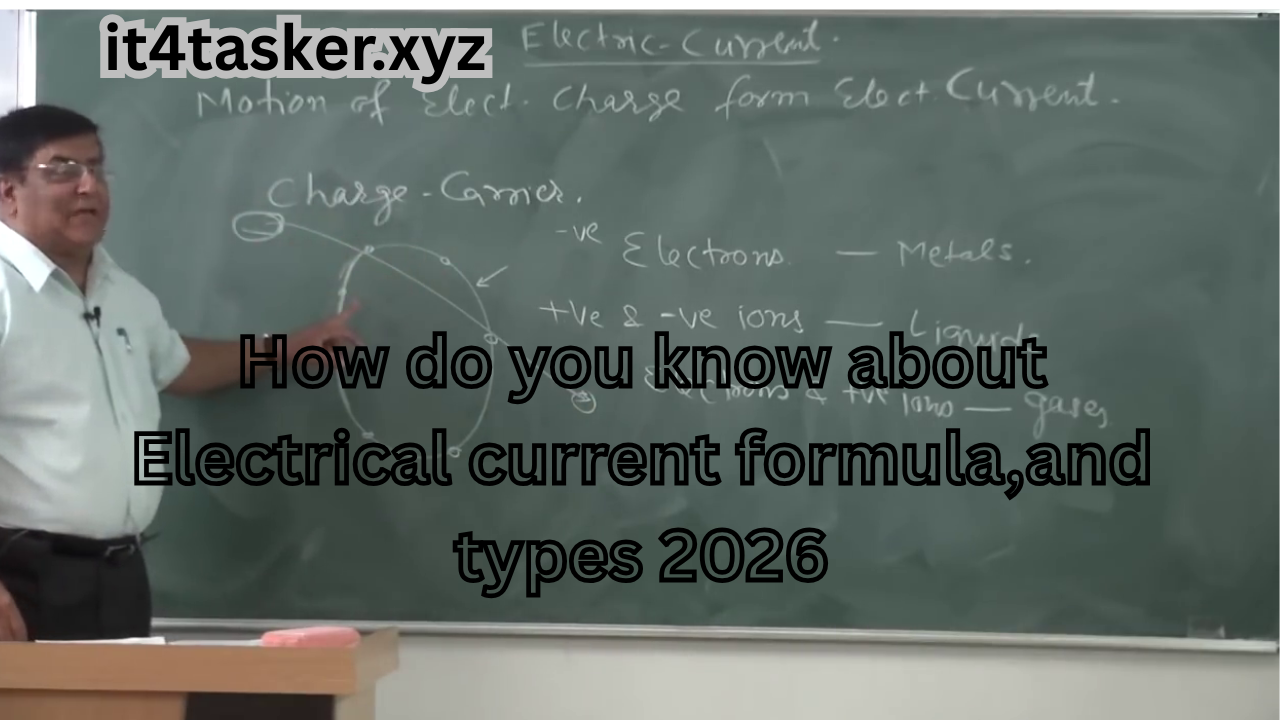
Electrical current, which is called Electrical Current in English, is a fundamental concept in electrical engineering and physics. If you have ever seen a light bulb light up, charged a mobile phone, or turned on a fan, then you have actually used electric current. In simple words, when electrons move inside a wire, it is called electric current. This movement is what makes our homes, factories, and electronic devices run.
In today’s modern world, it is difficult to imagine life without electric current. Computers, the internet, mobile phones, refrigerators, ACs, everything runs because of this current. Therefore, it is very important for every student studying electrical technology to understand what electric current is, how it is formed, what is its formula, and how many types it has.
Examples of electric current in daily life:
We use electric current dozens of times every day, but often we don’t even realize it. For example, when you turn on the switch, electrons start moving inside the wire and the bulb lights up. Similarly, current flows inside the battery during mobile charging. Car battery, solar system, UPS and generator all work on electric current.
If there is no electric current, most of the world’s systems will stop. That is why it is considered one of the most important inventions of modern times.
Simple definition of electric current:
A simple definition of electric current is that the organized movement of electrons inside a conductor is called electric current. This movement occurs when there is a voltage difference between two points.
What is the movement of electrons:
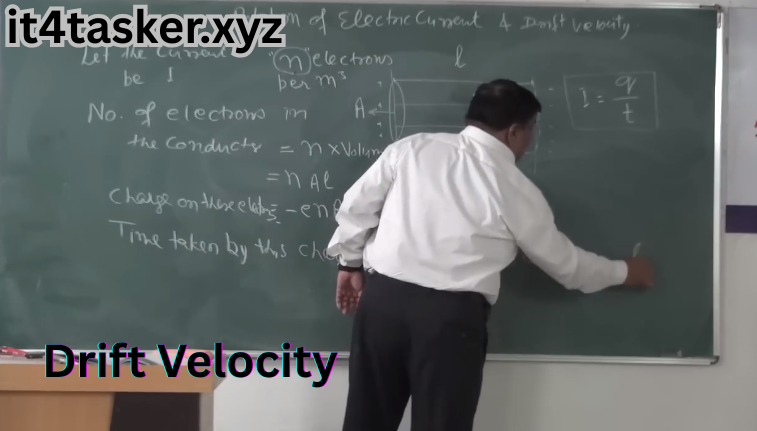
Every substance is made of atoms and electrons are present inside atoms. In metals, electrons are free, so when voltage is applied, they start moving. This movement becomes electric current.
For example, electrons move easily in a copper wire, which is why wires are made of copper. If the wire is made of wood, then the current will not flow because wood is not a conductor.
Electric Current Formula:
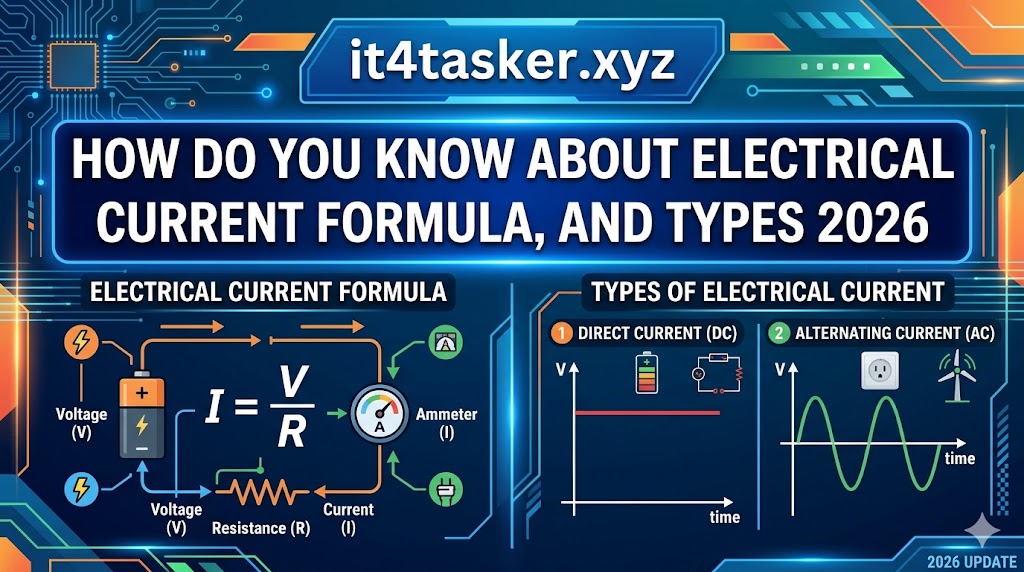
A simple formula is used to calculate electric current.
Explanation of the formula
In this formula,
I = Current
Q = Charge
t = Time
This means that if the amount of charge passes through a wire in a certain time, the greater the current will be. If the charge is high, the current will be high, if the time is high, the current will be low.
This formula is used in all basic physics and electrical calculations.
What is the SI unit of current:
The SI unit of electric current is Ampere. It is abbreviated as A. If one coulomb of charge passes through a wire in one second, the current will be one ampere.
What is an ampere
Ampere actually tells the amount of current. For example
- Mobile charger → 1A or 2A
- Home circuit → 5A or 10A
- Heater → 15A or more
More amperes means more current, and more current means more power.
How is electric current generated:
Electric current is generated when voltage is applied to a circuit. Voltage makes electrons move and resistance makes this movement more or less.
Role of voltage and resistance
If the voltage is high, the current will be high, but if the resistance is high, the current will be low. All electrical appliances work on this principle.
For example, a light bulb has resistance, so it burns. If there is no resistance, a short circuit will occur.
Types of electric current:
There are two basic types of electric current.
Direct Current (DC)
DC is a current that flows in one direction. DC is used in batteries, solar panels and mobile chargers. In it, the direction of the voltage does not change.
Alternating Current (AC)
AC is a current whose direction changes repeatedly. The electricity coming to homes is AC. In Pakistan, a frequency of 50Hz is generally used.
Difference between AC and DC
| Feature | DC | AC |
|---|---|---|
| Direction | One direction | Keeps changing |
| Use | Battery, solar | Home electricity |
| Frequency | Not | Is |
Ohm’s Law and Current:
Ohm’s Law is very important for understanding current.
Explanation of Ohm’s Law
In this formula
V = Voltage
I = Current
R = Resistance
If the voltage is increased, the current will increase, if the resistance is increased, the current will decrease.
This law is used in every electrical circuit.
How is current measured:
An Ammeter is used to measure current. It is connected in series in the circuit.
Use of an emitter
If the emitter is connected incorrectly, the circuit can be damaged, so it must always be connected in series.
Uses of electric current:
Modern life is impossible without electric current.
Home use
Bulbs, fans, refrigerators, washing machines, ACs all run on current in the house. If there is no electricity, everything turns off.
Industrial Use
Motors, machines, welding, PLC systems in factories all run on electric current. AC is mostly used in industries while DC is used in electronics.

Conclusion:
Electric current is the basic part of electrical science. Without it, no machine can run and modern life is not possible. We learned in this article what electric current is, what is its formula, what is its unit, and how many types it has. If a student wants to go into the electrical field, it is important for him to fully understand the concept of current because it forms the basis of motors, generators, transformers, and circuits going forward.
FAQs:
1. What is electric current?
The movement of electrons inside a conductor is called electric current.
2. What is the formula of current?
I = Q / t
3. What is the unit of current?
Ampere
4. What is the difference between AC and DC?
DC flows in one direction while AC keeps changing direction.
5. How is current measured?
It is measured using an ammeter.