Introduction:
The relationship between electricity and magnetism is considered very important in physics. All the machines, motors, generators, transformers, mobile chargers, power stations and electric appliances that are being used in today’s modern world are based on Electromagnetic Induction. There are three very important things within this subject which are called EMF, Faraday’s Law and Lenz Law. If a student is studying electrical technology, physics or engineering, then it is very important for him to understand these laws.
In simple words, when the magnetic field around a wire or coil changes, electricity is generated in that wire. This process is called Electromagnetic Induction. This principle was first discovered by Michael Faraday, that is why his law is called Faraday’s Law. Later, another scientist Lenz gave a law that tells us what the direction of the generated current will be, it is called Lenz Law. In this whole process, the force that forces the current to flow is called EMF.
In this article, we will understand these three things in simple language in detail so that every student can remember it easily.
What is EMF
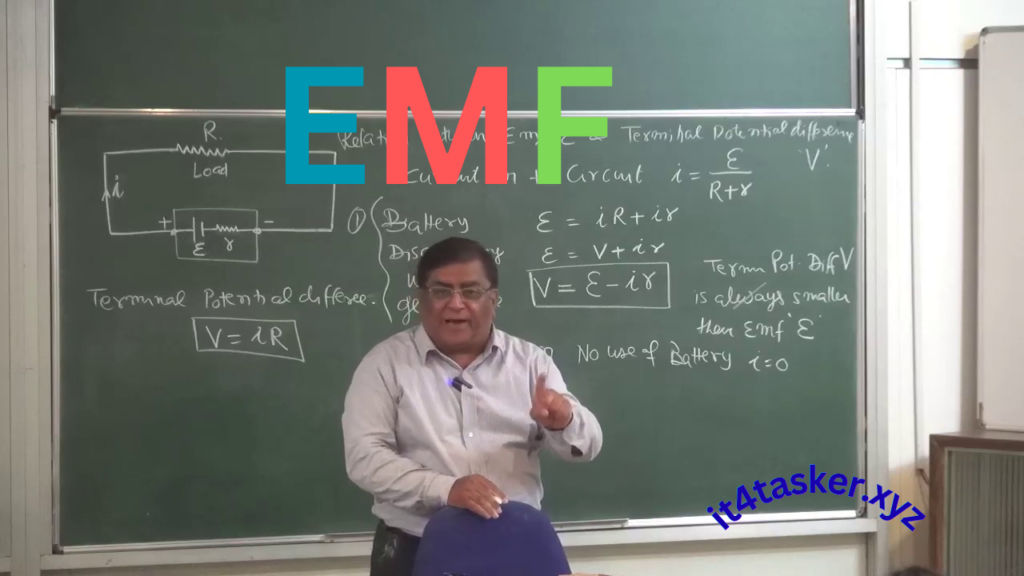
The full name of EMF is Electromotive Force. From the name it seems that it is a force, but in reality it is not a force but an energy that forces electrons to move in the circuit. When we put a battery in a circuit, the battery provides EMF due to which the current starts flowing. Similarly, when a generator runs, it also produces EMF.
We can understand EMF as the force that helps electricity to flow. If EMF is not present, then current will never flow in the circuit. In physics, the unit of EMF is Volt, which is also the unit of voltage. That is why most students consider EMF and voltage to be the same thing, although there is a slight difference between the two.
A simple example to understand EMF is to look at a water pump. The pump pushes water forward, in the same way EMF forces electrons to move forward. The higher the EMF, the more current will be generated.
What is Electromagnetic Induction
Electromagnetic Induction is the process in which electricity is generated in a wire or coil due to a change in the magnetic field. If a magnet is moved near a coil, a current is generated in the coil. But if the magnet is kept stationary, no current will be generated. This means that there must be a change, only then will induction occur.
This same principle is used in generators. In generators, the coil is rotated within a magnetic field, due to which the magnetic field keeps changing continuously and current is generated. In power stations, thousands of volts of electricity are generated in the same way.
The principle of electromagnetic induction is one of the most important discoveries of modern times, because without it, large-scale electricity generation would not have been possible.
What is Faraday’s Law
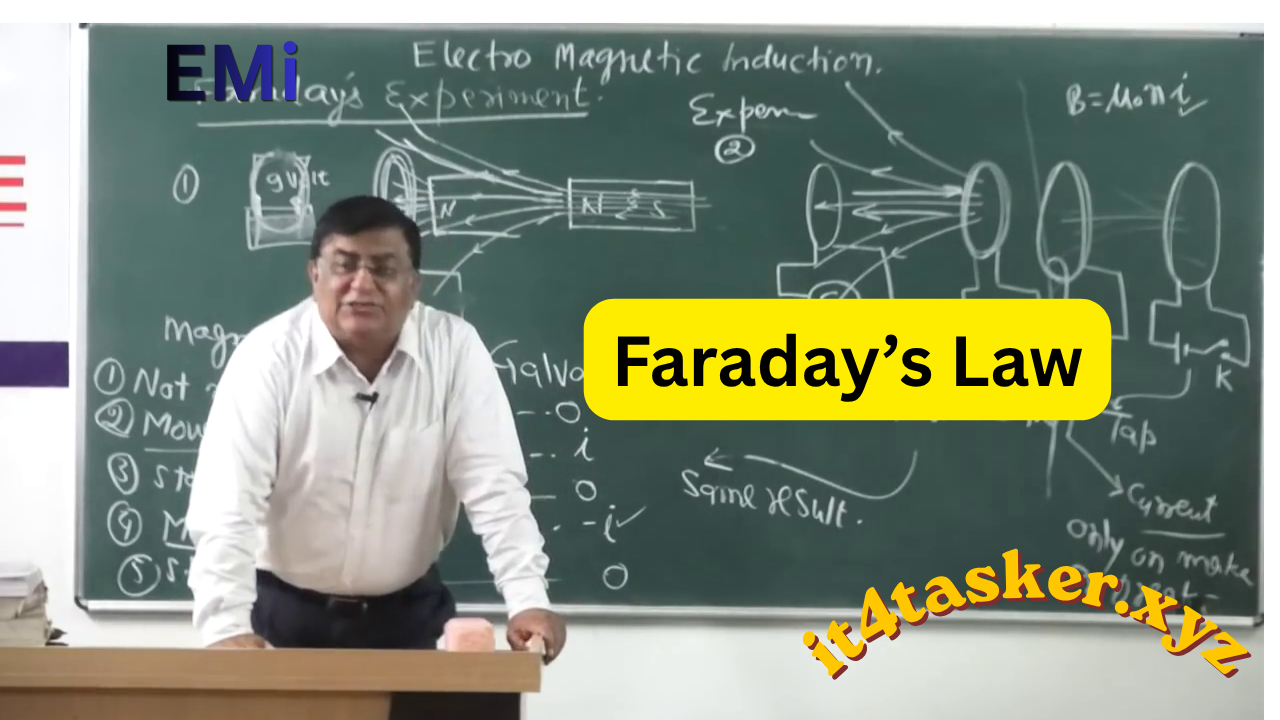
Faraday’s Law was first discovered by Michael Faraday in 1831. According to this law, whenever the magnetic flux passing through a coil changes, an EMF is generated in that coil.
Faraday’s law consists of two parts.
The first law states that when the magnetic field changes, an EMF is generated in the conductor.
The second law states that the amount of EMF generated depends on how fast the magnetic flux is changing.
In simple words, if the magnet is moved quickly, more EMF will be generated, and if it is moved slowly, less EMF will be generated. Due to this principle, large generators are run at high speeds to produce more electricity.
Faraday’s Law is written in mathematical language in such a way that the EMF is related to the change in magnetic flux. The negative sign indicates that the current generated opposes the change, which was later further clarified in Lenz Law.
What is Lenz’s Law
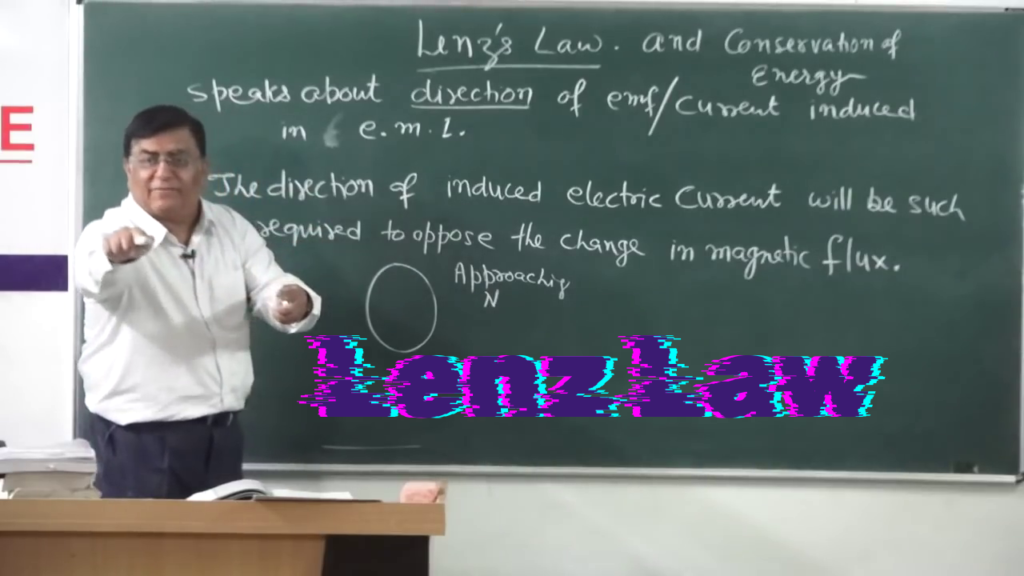
Lenz’s Law tells us what the direction of the current produced by induction will be. According to this law, the current produced always opposes the change that caused it.
This may sound difficult to hear, but it can be explained with a simple example. If you take a magnet inside a coil, a current will be produced in the coil that will prevent the magnet from entering. And if you take the magnet out, the current will be in a direction that will try to pull the magnet back.
This means that nature always opposes change. This is why Lenz’s Law uses a negative sign, which is also included in the formula of Faraday’s Law.
This law is very important because it tells us the direction of the current, which is necessary when designing a circuit.
‘
Factors affecting EMF
The amount of EMF is not always the same, but depends on different things.
The first thing is the strength of the magnetic field. The stronger the magnet, the more EMF will be generated.
The second thing is the number of turns of the coil. If there are more turns in the coil, the more EMF will be generated.
The third thing is the speed. If the coil is rotated quickly, the EMF will be more, and if it is rotated slowly, the less will be generated.
The fourth thing is the area. If the area of the coil is large, the magnetic flux will be large and the EMF will also be large.
Uses in daily life
Electromagnetic induction is used everywhere. Electricity is generated by the same principle in generators. Transformers reduce or increase voltage by the same principle. The same principle also works in motors. Mobile chargers, induction cookers, microphones and speakers all follow the same law.
In a power station, the turbine rotates, the turbine rotates the generator, the generator rotates the coil in the magnetic field and an EMF is generated in the coil. This EMF later reaches the homes as electricity.
Conclusion
EMF, Faraday’s Law and Lenz Law are the basic principles of physics that tell us how electricity is generated and how it operates. The discovery of electromagnetic induction changed the world because with its help it became possible to generate electricity on a large scale. If a student wants to go into the field of electrical or physics, it is important for him to understand these laws well. When you understand these principles, you automatically start understanding the working of generators, motors and transformer.
10 important question asking every times:
1. What is EMF?
EMF stands for Electromotive Force. It is the energy that forces electrons to move in a circuit and helps current flow.
2. What is Electromagnetic Induction?
When there is a change in the magnetic field around a conductor and due to this, electricity is generated, this process is called Electromagnetic Induction.
3. What does Faraday’s Law say?
According to Faraday’s Law, when there is a change in magnetic flux, an EMF is generated in the conductor.
4. What is Lenz Law?
According to Lenz Law, the current generated always opposes the change that caused it.
5. What is the unit of EMF?
The unit of EMF is Volt, which is also the unit of voltage.
6. On what principle does a generator work?
The generator works on the principle of electromagnetic induction, in which a coil is rotated in a magnetic field and an EMF is generated.
7. How is Faraday’s Law used in a transformer?
Due to the change in the magnetic field in a transformer, an EMF is generated in the other coil, which is in accordance with Faraday’s Law.
8. What is magnetic flux?
Magnetic flux is the quantity that tells how much magnetic field is passing through an area.
9. How is more EMF generated?
To generate more EMF, it is necessary to change the magnetic field faster, increase the turns of the coil, and increase the speed.
10. What is an example of electromagnetic induction in everyday life?
Generator, motor, transformer, induction cooker, and mobile charger are all examples of electromagnetic induction.