
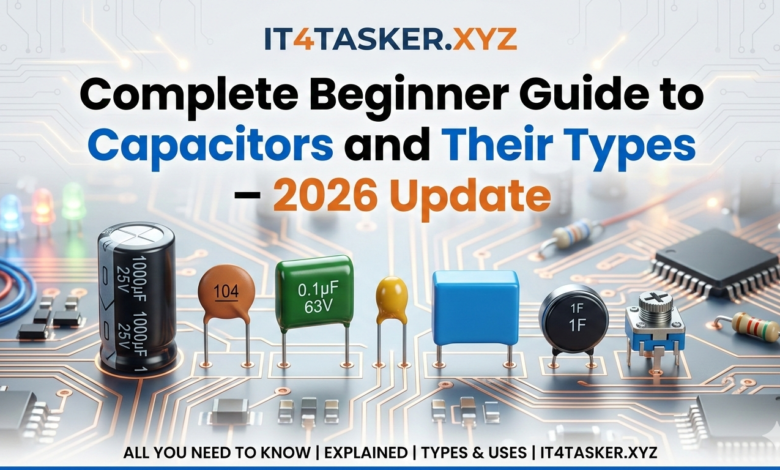
Introduction:
My mind was dizzy when I heard the name of a capacitor. What does this small component do? It looks like a battery but it is not. It is seen everywhere in the circuit, but I do not understand it.
Simple explanation:
Today I thought I would explain this topic in very simple and easy english , like a friend explaining it to a friend. No heavy words, no complicated formulas — just straight talk.
What is a capacitor?
Look, let’s start with the simplest example. Have you ever seen a ball filled with water? When you squeeze it, the water comes out, and when you release it, it fills up again. A capacitor does something similar — only instead of water, electricity is present.
A capacitor is an electronic component that stores electricity for a short time and then gives it back when needed.
It is different from a battery because a battery charges and discharges very slowly — a capacitor does this in the blink of an eye. That is its specialty and what makes it different from a battery.
How is it made inside?
A capacitor looks small, but it is very powerful inside. It consists of two metal plates that are completely separated from each other. Between them is a special material called a dielectric — this is what prevents electricity from passing from one plate to the other.
When you connect a capacitor to an electrical source, a positive charge accumulates on one plate and a negative charge on the other plate. The dielectric material in between holds this charge. As soon as the power source is removed, the capacitor releases this stored charge slowly or all at once — as needed.
How to measure a capacitor:
The capacity of a capacitor is measured in Farads. But the truth is that 1 farad is a very large value in a typical electronic circuit. That is why smaller units like microfarad and picofarad are usually used.
A simple example — the capacitor installed in your home fan is usually 2.5µF to 5µF. And the capacitors installed on the circuit board of a mobile phone are hardly visible to the naked eye, they are in picofarads.
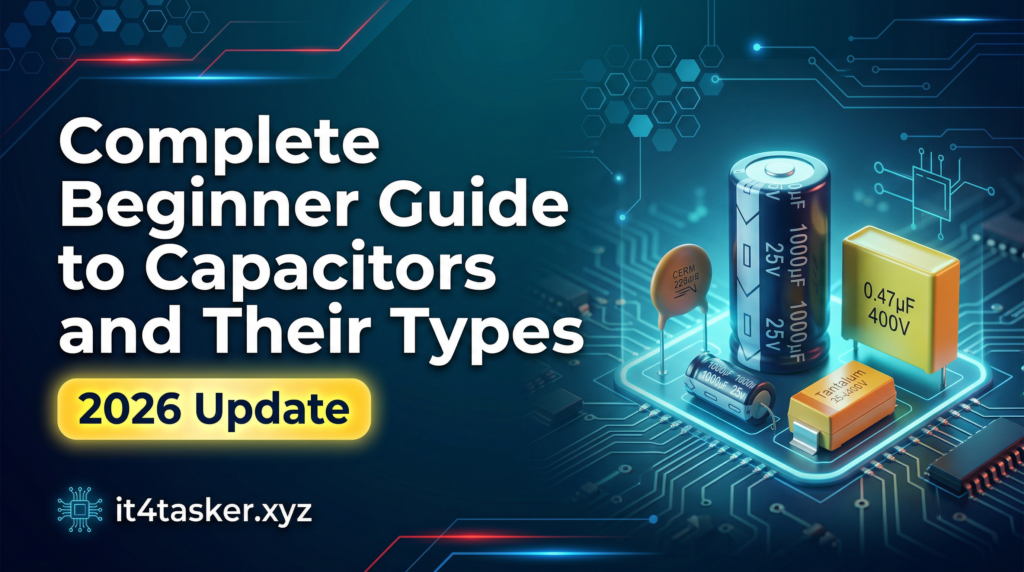
Types of capacitors:
This is the part you came here for. There are many types of capacitors and each has its own function and place. Let’s understand one by one.
First type — Ceramic capacitor:
This is the most common and most commonly found capacitor. If you pick up any old circuit board, you will see small round or flat spots on it — these are ceramic capacitors.
It uses ceramic material as the dielectric, which is a special material similar to clay. These capacitors are very small in size, cheap, and work very well at high frequencies.
Mobile phones, computers, televisions — ceramic capacitors are everywhere. If you are new to electronics, learn to recognize these capacitors first.
Second type — Electrolytic capacitor:
Now this is a slightly larger and more visible capacitor — cylindrical in shape, with a small line on top. This is the same capacitor that sometimes bulges out of old TVs or radios!
Its feature is that it can store a lot of capacitance — that’s why it is most often used in power supply circuits.
But one important thing! This capacitor is polarized, meaning that one leg is positive (+) and the other is negative (−). If it is accidentally installed upside down, it can heat up and explode. So if you ever install it, the side with the line on the plate is the negative leg — remember.
Third type — Tantalum capacitor:
This is a better and more reliable type of electrolytic capacitor. It uses a metal called tantalum, which is a valuable and strong metal.
Smaller in size, better in performance — that’s why this capacitor is used in smartphones, laptops, and medical devices. However, it is certainly expensive. Another thing — it must also be installed with the correct polarity, otherwise it can be damaged.
Fourth type — Film capacitor:
This capacitor uses a thin plastic film as a dielectric. It is usually a little larger and is yellow or orange in color.
If you have ever opened an old tape recorder or audio amplifier, those yellow block-like parts are film capacitors. It is considered very good for audio circuits because it does not change much with temperature and remains very stable. The same film capacitor is also used in fan motor starters.
Fifth type — Super capacitor:
Now this is something really different. A normal capacitor stores a little energy, but a super capacitor can store thousands of times more energy. It is something between a capacitor and a battery — neither a full battery nor a full capacitor.
In electric vehicles, when the brakes are applied, the supercapacitor stores the energy that is lost and then reuses it. It is also now being widely used in solar systems. It can be charged millions of times — while a normal battery can only be charged a few hundred times.
Sixth type — Variable capacitor:
The special feature of this capacitor is that its value can be changed by rotating it. The tuning dial that was rotated in old AM/FM radios was behind this variable capacitor.
Nowadays, radios have gone digital, so its use has decreased, but it is still found in RF transmitters and old radio circuits.
Seventh type — Mica capacitor:
Mica is a natural mineral and capacitors made from it are very accurate and reliable. It works very well at high frequencies and does not change its value despite temperature.
In RF transmitters and military electronics, where extreme accuracy is required, mica capacitors are used. They are rarely found in the general market and are also expensive.
QUESTION:
“❓💸 Have questions about Capacitors and how it can change your life? 💰✨
❓💡 Curious about how capacitors actually work? ⚡🔧
🔍📊 Want to learn the different types and their uses? 📝💻
💭💡 Wondering why capacitors are so important in electronics? ⚙️🔋
🚀⚡ Looking for simple explanations for beginners? 👶📘
💬🔥 Ready to boost your electronics knowledge today? ⚡💡
👇🎯 Dive in and explore the full guide now! 📘✨
“