Introduction:
Welcome to the modern tech world! Ever wonder how your smartphone manages energy so well? It often starts with a small partt that guides power throughout the circuit.
These semiconductor diodes act as one-way gates for electrical current. By controlling this flow, such electronic components protect gadgets from sudden damage.

The magic within circuits depends on precise control. You see these tiny units in everything from flashlights to computers. Such parts ensure electricity moves exactly where needed.
Understanding various types of diodes helps you grasp how gear functions today. This knowledge remains essential for anyone curious about the future. Small parts make a huge difference in every device.
Key Takeaways
- These units act as one-way valves for electricity.
- They serve as critical guards for hardware.
- Silicon materials make these parts small.
- Specialized designs handle tasks like lighting.
- Mastering basics unlocks engineering secrets.
- Small builds ensure devices stay cool.
Understanding the Fundamentals of Diodes
The diode is a key part of electronic circuits. It’s important to know what a diode is and how it works.
Basic Definition and Purpose
A diode is a semiconductor device. It lets current flow in one direction but blocks it in the other. This makes diodes very useful in many things, like simple rectifiers and complex circuits.
The Role of Semiconductors in Diode Construction
Semiconductors are materials that are not too good at conducting electricity. Silicon is often used because it’s common and well-studied. It’s “doped” with special materials to make it work better.

Historical Development and Modern Relevance
The idea of the diode started in the early 1900s. The first vacuum tube diodes were made then. The semiconductor diode came later and changed things a lot.
Now, diodes are everywhere in electronics. They help with power, signals, and protection. New materials and ways of making diodes are always being found.
The history of diodes has seen big changes. From vacuum tubes to semiconductor devices, and now to new materials like SiC and GaN. These changes have made diodes better and more useful.

How Diodes Work: The Science Behind One-Way Current Flow
Diodes work because of semiconductor physics. This is about the P-N junction. It’s key to knowing how diodes control current.
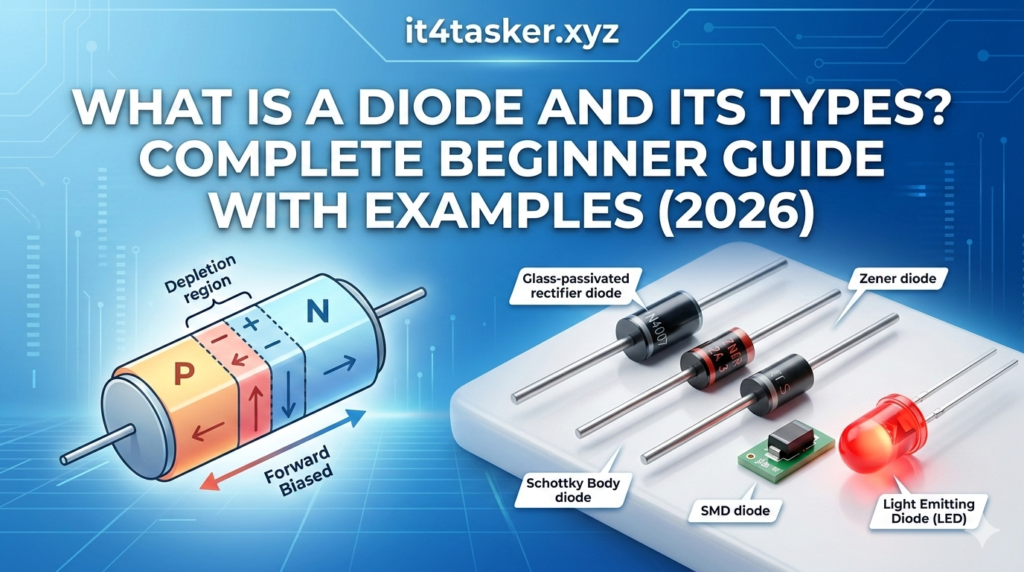
The P-N Junction Explained
The P-N junction mixes P-type and N-type semiconductors. P-type semiconductors have more holes (positive charges). N-type semiconductors have more electrons (negative charges).
P-Type and N-Type Semiconductors
P-type and N-type semiconductors make the P-N junction. They mix holes from P-type and electrons from N-type.
Depletion Region Formation
When P-type and N-type mix, electrons fill holes. This creates a depletion region around the junction. This region blocks current flow.

Forward Bias Operation
Forward bias means the P-side gets a positive voltage. The N-side gets a negative voltage. This makes the diode let current through.
Reverse Bias Operation
Reverse bias means the opposite. The P-side gets a negative voltage, and the N-side gets a positive voltage. This stops current from flowing.
Breakdown Mechanisms
High voltage can make diodes break down. There are two main ways: the Zener effect and avalanche breakdown. Knowing these helps use diodes right.
Essential Characteristics and Parameters of Diodes
To make circuits work better, we need to know about diodes. Diodes are key in many electronic circuits. Their features greatly affect how well circuits work and how efficient they are.
Forward Voltage Drop and Threshold Voltage
The forward voltage drop shows how much voltage is lost when a diode is on. This is very important in power conversion because we want to be efficient. The threshold voltage is the lowest voltage needed for a diode to start conducting well.
Diodes of different types have different forward voltage drops. For example, silicon diodes lose about 0.7 volts. Schottky diodes lose less, about 0.2-0.3 volts.
Reverse Breakdown Voltage
The reverse breakdown voltage is key. It’s the highest reverse voltage a diode can take before it fails. Going over this can damage the diode.
Diodes are made for different uses. For example, Zener diodes are made to handle reverse breakdown and are used for voltage control.
Current Rating and Maximum Power Dissipation
The current rating tells us the max current a diode can handle. Going over this can cause it to overheat and fail. The maximum power dissipation is about how much power a diode can handle without failing. It depends on the current rating and forward voltage drop.
| Diode Type | Current Rating (A) | Maximum Power Dissipation (W) |
|---|---|---|
| 1N4001 | 1 | 3 |
| 1N5401 | 3 | 5 |
| Schottky Diode (1N5819) | 1 | 2 |
Switching Speed and Recovery Time
The switching speed and recovery time are important for fast circuits. Switching speed is how fast a diode can switch on and off. Recovery time is how long it takes for a diode to stop conducting after it was on.
Knowing these details helps us pick the right diode for our needs. This ensures our circuits work well and reliably.
Standard Rectifier Diodes: The Workhorses of Power Conversion
Standard rectifier diodes are key in power conversion systems. They change AC to DC power well. They are used in many places, from simple power supplies to big industrial systems.
Construction and Operating Principles
Rectifier diodes use a P-N junction. This is what lets them carry current in one direction but not the other. The P-N junction is made by mixing P-type and N-type materials.
When a positive voltage is applied, the diode lets current flow. But when the voltage is reversed, it blocks current.
Rectifier diodes can handle a lot of current and voltage. They are made to lose less energy during power conversion.
Half-Wave and Full-Wave Rectification
Rectifier diodes work in half-wave and full-wave circuits. Half-wave uses one diode for positive AC cycles to DC. Full-wave uses four diodes for both positive and negative cycles, making DC smoother.
- Half-wave is simpler but less efficient.
- Full-wave gives a smoother DC output.
Common Series and Specifications
Many series of rectifier diodes are used in circuits. The 1N4001 to 1N4007 series and high-current diodes are common.
1N4001 Through 1N4007 Series
The 1N4001 to 1N4007 series has different voltage ratings. The 1N4001 can handle up to 50V, and the 1N4007 up to 1000V. They are used for general rectification.
| Part Number | VRRM (V) |
|---|---|
| 1N4001 | 50 |
| 1N4007 | 1000 |
High-Current Rectifiers
High-current rectifiers are for big current needs. They are used in power supplies and motor control circuits. They handle more power than standard diodes.
They are key in cars and big industrial places where lots of power is needed.
Zener Diodes: Precision Voltage Regulation
Zener diodes are great for keeping voltage stable. They work best when they’re not supposed to, making them perfect for precise voltage control.
Zener Effect and Avalanche Breakdown Mechanism
Zener diodes use two ways to break down: the Zener effect and avalanche breakdown. The Zener effect happens at lower voltages and causes a big jump in current. Avalanche breakdown happens at higher voltages and is due to impact ionization.
“The Zener diode’s ability to regulate voltage is rooted in its unique breakdown characteristics, making it an indispensable component in electronic circuits.”
Voltage Regulation and Reference Applications
Zener diodes are great for keeping voltage steady. They’re perfect for places where a stable voltage is needed, like in power supplies.
| Application | Description | Benefits |
|---|---|---|
| Voltage Regulation | Maintaining a constant output voltage despite changes in input voltage or load current. | Stable voltage output, protection against voltage fluctuations. |
| Voltage Reference | Providing a stable voltage reference for circuits. | High precision, low noise. |
Power Rating and Heat Dissipation Considerations
When picking a Zener diode, think about its power rating and how it handles heat. The power rating shows how much power it can handle without failing. It’s key to keep it cool to make sure it works well.
“The power rating of a Zener diode is a critical parameter that must be carefully considered to ensure the reliability and longevity of the circuit.”
— Electronics Design Guide
Selecting the Right Zener Diode for Your Circuit
To find the right Zener diode, look at the voltage you need, its power rating, and what it’s packaged in. Also, check its tolerance and how it changes with temperature. This makes sure it fits your project’s needs.
- Determine the required Zener voltage and tolerance.
- Choose a diode with an appropriate power rating.
- Consider the package type and thermal characteristics.
Light Emitting Diodes: Illuminating the Modern World
Light Emitting Diodes (LEDs) have changed how we light our world. They are very efficient and versatile. LEDs are used in many areas, like lighting, displays, cars, and even growing plants.
LED Technology Evolution and Efficiency Gains
LEDs have grown a lot since they started. Early LEDs didn’t shine as bright or show as many colors. But, scientists kept working and made big improvements.
Now, LEDs are brighter, last longer, and show more colors.
Key advancements include:
- Improved semiconductor materials
- Enhanced thermal management
- Advanced packaging techniques
These changes make LEDs a top choice for many uses. They are used in homes, businesses, and more.
Color Generation and Wavelength Control
LEDs can make many colors. This is thanks to different materials and coatings.
Visible Spectrum LEDs
Visible spectrum LEDs are used in many ways. They light up homes, displays, and cars. They come in colors like red, green, blue, and white.
Ultraviolet and Infrared LEDs
LEDs also make ultraviolet (UV) and infrared (IR) light. UV LEDs help kill germs and cure things. IR LEDs are in remote controls and night vision gadgets.
High-Power LEDs for Lighting Applications
High-power LEDs shine very bright and are reliable. They are used for outdoor, industrial, and high bay lighting.
| LED Type | Lumen Output | Typical Application |
|---|---|---|
| Standard LED | Up to 100 lumens | General Lighting |
| High-Power LED | 100-1000 lumens | Outdoor, Industrial Lighting |
| COB LED | 1000+ lumens | High Bay, Commercial Lighting |
Smart and Addressable LED Technology in 2026
Smart LEDs have changed lighting control and design. Addressable LEDs like WS2812B and SK6812 can be controlled one by one. This lets people make cool lighting effects.
WS2812B and SK6812 Addressable LEDs
WS2812B and SK6812 are easy to use and flexible. They are great for decorative, stage, and DIY projects.
“The flexibility and programmability of addressable LEDs like WS2812B and SK6812 have revolutionized the field of lighting design, enabling the creation of dynamic and interactive lighting systems.”
— LED Lighting Expert
COB and CSP LED Packages
COB and CSP LEDs are new in packaging. COB LEDs are very bright and cool. CSP LEDs are small and dense for many uses.
LEDs are getting even better. Scientists are working on making them more efficient, colorful, and smart.
Schottky Diodes: Fast Switching and Superior Efficiency
Schottky diodes have a special metal-semiconductor junction. They switch fast and use less power than other diodes.
Metal-Semiconductor Junction Technology
Schottky diodes have a metal-semiconductor junction. This makes their forward voltage drop very low. It’s between 0.15 to 0.45 volts.
Low Forward Voltage Drop Advantages
The low forward voltage drop of Schottky diodes means less power loss. This makes them more efficient in many uses. It’s great for power conversion circuits.
High-Frequency Switching Applications
Schottky diodes are great for high-frequency switching. They switch fast and handle high-frequency signals well. They are used in many areas.
Switch-Mode Power Supplies
In switch-mode power supplies, Schottky diodes are key. They help with rectification and freewheeling. Their fast switching and low voltage drop improve efficiency.
RF Detection and Mixing
Schottky diodes are also good for RF detection and mixing. They handle high-frequency signals well. Their non-linear nature is perfect for mixing and detecting RF signals.
Popular Schottky Diode Series
Many makers offer Schottky diode series for different needs. The 1N581x and 1N582x families are popular. They can handle a lot of current and have low forward voltage drops.
Photodiodes: Light Detection and Optical Communication
Photodiodes are key in turning light into electrical signals. They are very sensitive to light. This makes them very useful in many areas.
Photovoltaic and Photoconductive Operating Modes
Photodiodes work in two main ways: photovoltaic and photoconductive. In photovoltaic mode, they make a voltage when light hits them. This is like a solar cell.
In photoconductive mode, a special voltage makes them faster and more sensitive. This mode is great for fast systems like optical communication.
Types of Photodiodes
There are many kinds of photodiodes, each with its own special features and uses.
PIN Photodiodes
PIN photodiodes have a special layer that makes them very fast and sensitive. They are often used in quick optical systems.
Avalanche Photodiodes
Avalanche photodiodes (APDs) get very sensitive with a special voltage. They are great for catching very faint light, like in some fiber optic systems.
Schottky Photodiodes
Schottky photodiodes use a metal and semiconductor together. This makes them very fast and good for high-frequency tasks.
Applications in Sensors and Fiber Optic Systems
Photodiodes are very important in sensors and fiber optic systems. In sensors, they help measure light, distance, and more. In fiber optic systems, they turn light from the fiber into electrical signals.
Spectral Response and Sensitivity
The spectral response of a photodiode shows how well it catches different light wavelengths. They can catch light from visible to infrared. How well a photodiode catches light is very important for its job.
Tunnel Diodes: Exploiting Quantum Mechanics
Tunnel diodes use quantum tunneling to get negative resistance. This is good for high-frequency uses. They work differently than regular diodes.
Quantum Tunneling Effect in Heavily Doped Junctions
The quantum tunneling effect is key for tunnel diodes. It happens in p-n junctions with lots of doping. The thin area lets carriers tunnel, not just move.
Heavy doping makes the area thin. This lets carriers tunnel. It’s a quantum thing in semiconductors.
Negative Resistance Region Characteristics
Tunnel diodes have a special negative resistance region. When voltage goes up, current goes down. This is because of quantum tunneling.
This makes them great for high-frequency oscillation or amplifying.
High-Frequency Oscillators and Amplifiers
Tunnel diodes are good for high-frequency oscillators and amplifiers. They can make stable oscillators at microwave frequencies.
They also boost weak signals at high frequencies. This is good for microwave amplifiers.
Limitations and Modern Alternatives
But, tunnel diodes have some limitations. They don’t like temperature changes and only work in a certain voltage range.
New stuff like Gunn diodes and other semiconductors are better. They work better and are easier to use in circuits.
Varactor Diodes: Voltage-Controlled Capacitance
Varactor diodes are special because they change their capacitance when the voltage changes. This makes them very useful in many areas, especially in communication systems.
Capacitance Variation with Reverse Bias
Varactor diodes change their capacitance when a voltage is applied. When the voltage goes up, the capacitance goes down. This helps in controlling the diode’s capacitance, which is great for tuning circuits.
Tuning Ratio and Q Factor
The tuning ratio of a varactor diode is very important. It shows how much the capacitance can change. The Q factor shows how well the diode stores energy. A higher Q factor means less loss and is better for high frequencies.
Applications in Communication Systems
Varactor diodes are key in communication systems because of their ability to change capacitance with voltage. They are especially useful for tuning or modulating frequencies.
Voltage-Controlled Oscillators
Voltage-Controlled Oscillators (VCOs) use varactor diodes to change frequency with voltage. This is very important for phase-locked loops and frequency synthesizers.
Frequency Modulators and Phase Shifters
Varactor diodes also help in frequency modulators to change the carrier signal’s frequency. They are used in phase shifters too, to adjust signal phases. This is vital for phased array antennas and more.
| Parameter | Description | Importance |
|---|---|---|
| Tuning Ratio | Ratio of maximum to minimum capacitance | High tuning ratio allows for wider capacitance variation |
| Q Factor | Measure of energy storage vs. energy loss | Higher Q factor indicates lower losses, crucial for high-frequency applications |
| Reverse Bias Voltage | Voltage applied to control capacitance | Controls the width of the depletion region, thus capacitance |
PIN Diodes: Versatile RF and Microwave Components
PIN diodes are very useful in RF and microwave fields. They help with switching, reducing signal strength, and detecting signals. Their special design makes them key in many high-frequency systems.
Intrinsic Layer Structure and Benefits
PIN diodes have a special layer in the middle. This layer is between two types of semiconductor materials. It helps them have low capacitance and high resistance when not conducting.
This middle layer also makes the diode work better at high frequencies. It leads to improved isolation and reduced insertion loss in RF circuits.
RF Switching and Signal Routing
PIN diodes are great for switching at high frequencies. They help make switches that keep signals separate. This is very important in many RF and microwave systems.
They also help route signals well. This is super useful in things like phones and radar systems.
Variable Attenuators and Limiters
PIN diodes are also used to change signal strength. By changing the current, they can adjust how much signal gets through. This is useful for controlling signal levels.
They also protect sensitive parts from too much power. By limiting the output, they keep things safe.
High-Speed Photodetection Capabilities
PIN diodes are also good at detecting light fast. Their middle layer absorbs light well. This makes them great for detecting light in optical systems.
They can respond very quickly. This is important for fast data in modern networks.
What is Diode and Different Types of Diode 2026: Advanced and Emerging Technologies
New technologies are changing diodes in many ways. They make diodes better, smaller, and more useful for today’s electronics.
Silicon Carbide SiC Diodes for High-Power Applications
Silicon Carbide (SiC) diodes are a big step up for high-power needs. They work better than old silicon diodes, especially in temperature tolerance and efficiency.
Temperature Tolerance and Efficiency
SiC diodes handle heat better and lose less power when switching. This makes them great for high-power uses. They help convert power more efficiently and make less heat.
Electric Vehicle and Renewable Energy Use
SiC diodes are great for electric cars and green energy. They help manage power better. This makes these systems more efficient and reliable.
| Characteristics | SiC Diodes | Traditional Silicon Diodes |
|---|---|---|
| Temperature Tolerance | Higher | Lower |
| Switching Losses | Lower | Higher |
| Efficiency | Higher | Lower |
Gallium Nitride GaN Diodes
Gallium Nitride (GaN) diodes are another big leap, especially for high-speed needs. They have high-frequency performance and help make compact power converters.
High-Frequency Performance
GaN diodes work at much higher speeds than old silicon diodes. They’re perfect for fast switching needs.
Compact Power Converter Designs
GaN diodes let us make smaller, more efficient power converters. This is key for today’s devices where space is limited.
Organic and Flexible Diodes
Organic and flexible diodes are new and exciting. They’re made from materials that can be printed on flexible bases. This is great for wearable tech and flexible screens.
Quantum Dot and Perovskite Diodes
Quantum dot and perovskite diodes are new and could change displays and lights. They might make colors clearer, use less power, and be more flexible.
The new diode tech, like SiC, GaN, organic, quantum dot, and perovskite diodes, will change many fields. They will make devices more efficient, smaller, and more versatile.
Real-World Applications of Diodes Across Industries
Diodes are key in many modern technologies. They are used in power electronics, telecommunications, and more. Their ability to work well in many places makes them very important.
Power Electronics and Energy Management Systems
Diodes are key in power electronics. They help change and manage electrical energy well. They are used in many ways, like:
Solar Inverters and Battery Management
In solar inverters, diodes change DC power from solar panels to AC power for the grid. They also protect batteries from overcharging and help charge them efficiently.
Industrial Power Supplies
Diodes change AC voltage to DC voltage for industrial equipment. High-power diodes are great for this because they can handle a lot of current and voltage.
| Application | Diode Type | Key Benefits |
|---|---|---|
| Solar Inverters | High-Power Rectifier Diodes | Efficient DC-AC conversion, high reliability |
| Battery Management | Schottky Diodes | Low forward voltage drop, fast switching |
| Industrial Power Supplies | Rectifier Diodes | High current handling, robust construction |
Telecommunications and Data Transfer
In telecommunications, diodes are key for signal processing and data transfer. They are used in:
Fiber Optic Networks
Photodiodes turn light signals into electrical signals. This lets data travel fast over long distances in fiber optic networks.
5G and Millimeter-Wave Systems
Schottky diodes are used in 5G and millimeter-wave systems. They work well at high frequencies and are quiet.
Automotive Electronics and Electric Vehicles
The car industry uses diodes a lot. They are used in:
Electric vehicles use diodes in their power systems. This helps manage electrical energy well.
Consumer Electronics and Internet of Things
Diodes are also in consumer electronics. They are in LED lights, power adapters, and portable devices. They are efficient and small, making them perfect for these uses.
In conclusion, diodes are very important in many fields. They help make technology better and more efficient. Their many uses show how crucial they are in today’s electronics.
Latest Innovations and Future Trends in Diode Technology
Diode technology is changing fast. New materials and ways to make them are leading the way. This is making electronics better, smaller, and smarter.
New diodes are better at what they do. They use less energy and last longer. Efficiency improvements are a big focus. Scientists are looking at new materials and designs to make them better.
Efficiency Improvements and Thermal Management
Keeping diodes cool is a big challenge. New ways to manage heat are being found. For example, silicon carbide (SiC) and gallium nitride (GaN) are being used for high-power needs.
“Using SiC and GaN in diodes is a big step forward,” says an expert. These materials help diodes work better and last longer.
Miniaturization and High-Density Integration
Diodes are getting smaller and more efficient. This is great for gadgets and IoT devices. New materials and packaging are making diodes smaller and better.
Artificial Intelligence and Smart Diode Systems
Artificial intelligence (AI) is being used in diodes. AI helps diodes work better and last longer. Smart diodes can change how they work to be more efficient.
- Predictive maintenance
- Real-time performance optimization
- Enhanced system reliability
Sustainable Manufacturing and Recycling Initiatives
The electronics world is getting greener. Diode makers are using eco-friendly materials and recycling. This includes making diodes that are better for the planet and recycling old ones.
Next-Generation Materials and Nanostructures
New materials and nanostructures are being studied. Graphene and other 2D semiconductors could make diodes even better. They could lead to big improvements in how diodes work.
The future of diodes is bright. We will see diodes that are more efficient, smaller, and smarter. This will help many industries move forward.
Conclusion
Diodes are key in today’s electronics. They help with power, voltage, lighting, and more. They are used in many ways.
There are many types of diodes. Each one is special for different jobs. This makes them very useful.
Diode technology keeps getting better. New materials and designs make them more efficient. This leads to better electronics.
New diodes like Silicon Carbide and Gallium Nitride are coming. They will change high-power uses. Organic and flexible diodes will also bring new things.
Diode technology will keep getting better. We will see more efficient and smaller devices. This will help many areas like power, phones, cars, and more.
FAQ
What exactly is a diode and why is it so important in modern electronics?
A diode is like a one-way street for electricity. It lets current flow in one direction but blocks it in the other. This is key for protecting circuits and making light in displays.In 2026, diodes are still vital for things like phone chargers and electric car power grids.
What is the difference between a standard silicon diode and the newer SiC or GaN varieties?
Standard silicon diodes are good for everyday use because they’re reliable and affordable. But, SiC and GaN diodes are better for high-power and high-frequency tasks.They are made by companies like Wolfspeed and Infineon. They help with better thermal management and higher efficiency. This makes them great for renewable energy and 5G.
Why is the 1N4007 series often called the “workhorse” of rectifiers?
The 1N4001 to 1N4007 series is a workhorse because it’s tough and versatile. These diodes are key for turning AC from your wall outlet into DC for your electronics.
How do Zener diodes manage to regulate voltage so precisely?
Zener diodes are special because they work safely in reverse bias after a certain voltage. This lets them keep a constant voltage, making them perfect for power supplies.Brands like Nexperia offer many Zener diodes to protect sensitive parts from voltage spikes.
What makes addressable LEDs like the WS2812B different from a standard LED?
Standard LEDs just turn on when power is applied. But, smart LEDs like the WS2812B have a chip inside. This lets you control each light’s color and brightness.They’re perfect for dynamic RGB lighting in gaming and architecture.
When should I choose a Schottky diode over a regular rectifier?
Choose a Schottky diode, like those from STMicroelectronics, for efficiency and speed. They have a low forward voltage drop and almost no recovery time. This makes them great for SMPS and RF applications.
How do photodiodes facilitate high-speed internet through fiber optics?
Photodiodes, especially PIN and Avalanche types from Hamamatsu, are crucial for high-speed internet. They detect light pulses from fiber optic cables and turn them into electrical signals fast.This is how we get the fast data transfer needed for millimeter-wave and cloud computing.
What is a Varactor diode and where would I find one in my daily life?
A Varactor diode is like a voltage-controlled capacitor. It changes its capacitance with voltage. You’ll find them in car radios and phones, helping them tune into specific frequencies.
Are there any eco-friendly or sustainable innovations in diode manufacturing for 2026?
Yes! The industry is moving towards sustainable manufacturing. It’s reducing harmful materials and improving recycling for semiconductor wafers.It’s also exploring Organic Diodes and Perovskite materials for flexible, low-energy electronics. These are easier to make and can be used in biodegradable sensors for the IoT.
What is the role of a PIN diode in RF switching?
Pin diodes have a thick “Intrinsic” layer. This makes them almost perfect for RF switching or variable attenuation. In 2026, they’re key for 5G base stations and advanced radar systems.They handle high-frequency signals with very little distortion.






This guide about diodes is extremely detailed and helpful for 2026. I didn’t know that Schottky diodes had such a low forward voltage drop (0.15 to 0.45V) compared to standard silicon ones. The section on SiC and GaN diodes was also very interesting, as these technologies are essential for the efficiency of electric vehicles and 5G networks today. Thank you for the clear explanation on P-N junctions!